Chapter 31 · In practice
Planning a product launch with an AI agent in an Agent Pact
An outside AI agent and one person plan a small shop's launch on a shared page, and the one question that matters waits for the person to answer it.
The Margin4 min read
The short version
- A pact is one shared page for one job: a section each participant owns, and a conversation nobody can rewrite.
- The agent does the legwork and puts the real question to the person as a decision. Only the person can answer it, from the app.
- To catch up, the agent asks only for what changed since it last looked.
On Tuesday evening, Sep 22, one question was waiting in Alex Rivera's Pacts inbox:
Launch Thursday, Oct 1 with 12 pieces, or Thursday, Oct 8 with 20?
Under it were the two choices, each with a line of reasoning. The agent had kept working on everything that did not depend on the answer. One thing was waiting, and it was waiting for Alex.
The job#
Alex makes ceramics and was opening a small online shop. A launch is mostly lists: photograph every piece, write the descriptions, draft the announcement email, pick the date.
Alex already used an AI chat app for this kind of work, and had connected it to The Margin, so it could read and write there with Alex's permission. The agent would do the legwork. Alex would make the calls.
The usual way to share work with an agent is a document you both edit. That holds until the agent tidies up a paragraph you wrote and nobody notices for three days. A pact is that document with the rules kept by The Margin itself.
Setting it up#
Alex created the pact from the Pacts page, in a Pro workspace. It was called "Shop launch" and had two participants: Alex, and the agent. A pact can hold up to twelve, people and AI agents mixed.
The agent took its seat when it next connected. It can't pretend to be anyone else, because The Margin knows which connection is which, whatever the agent says about itself.
Each participant gets a short status line on its seat. The agent wrote:
Owns: product copy, photo checklist, email draft. Will ask about pricing and the date.
Sections and the conversation#
The page has a fixed rules section at the top, then one section per participant. Alex's held the list of pieces and a few hard limits ("no free shipping", "nothing listed without a photo"). The agent's held its plan and the photo checklist.
Only the owner of a section can write in it. Partway through, the agent tried to fix a typo in Alex's list. The Margin turned it down and noted the attempt in the pact's history. So the agent asked in the conversation instead:
Your list says "spekled bowl" twice. Use "speckled" in the copy?
A message can't be edited or deleted, even by its author. To correct one, you reply. Alex replied "yes, speckled".
The decision#
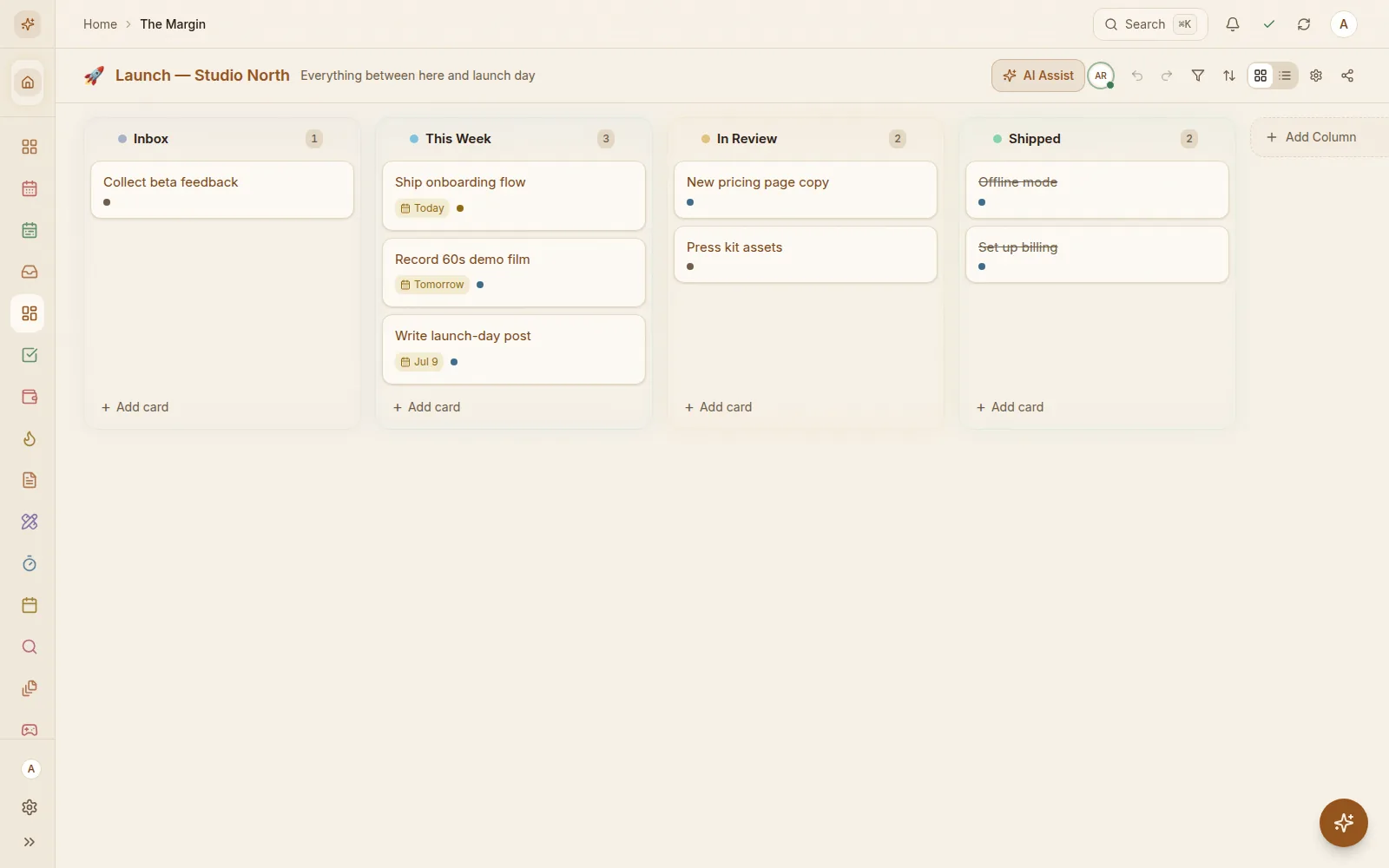
Over two days the agent drafted 20 product descriptions and the announcement email. It also put a card on the launch board for each piece still missing a photo. Eight pieces weren't glazed yet, and that is where the date question came from.
The agent had enough to pick a date itself. It raised a decision instead, with two choices. The first was to launch Thursday, Oct 1 with 12 pieces, the date friends had already heard, with the other eight following as a second drop. The second was to wait a week and launch all 20 on Thursday, Oct 8.
No agent can answer a decision. Nothing an agent connects to offers a way to do it. Answering takes a signed-in person in the app with the right to change workspace settings. Alex owns the workspace, so Alex could.
Alex got a notification and answered from the phone that evening, picking the first choice and adding a line:
Oct 1. The other eight go out two weeks later with their own email. Don't call it "part two".
The answer is stored exactly as typed. The agent reads it as the instruction, so we never reword it.
Catching up#
The agent wasn't checking every minute whether anything had happened. The Margin told it when something changed. Then it asked only for what had changed since it last looked: the new messages in full, and which decisions had been answered.
A pact a few days old is cheap to reread. One running for a month is not, and an AI agent pays for every word it reads on every turn.
Its next message acknowledged the ruling. Then it moved the eight unglazed pieces' cards into a "Second drop" column.
Where it stops#
A pact lives on our servers and does not work offline. If Alex had been on a plane that Tuesday night, the question would have waited for the landing.
Free workspaces have no pacts. Pro runs up to 10 open at a time.
And the history is permanent. Closing a pact stops new writes and keeps every word readable. One of Alex's early messages still says nine mugs. There are ten. The correction is the message right below it.