Chapter 27 · Trust
The back pages: a new break room, and two classics rebuilt by simulation
The break room became the last pages of a planner, with a small live window onto each game in the margin. Stack was too hard and Catch the Tasks ended at the same moment whatever you did; simulations said why, and the rebuilds were tuned until the numbers changed.
The Margin4 min read
Picture a player whose timing is off by a perfectly normal 60 milliseconds. In the old Stack, that person landed 23% of their cards clean, and their median pile came down at 9 cards.
The founder had put it more kindly. He said Stack was "a little bit too difficult", and asked for both classics, Stack and Catch the Tasks, to get "a do-over, better mechanics, and better theme integration". Before anybody touched a rule, both games were run through a simulated player to find out where the difficulty actually lived.
Stack#
It lived in three places. A card you let go of kept drifting 10 to 13 points in the direction of the swing while it fell, and the clean window was only 6 points wide, so releasing a card at the moment it sat over the pile was already a miss. The crane sped up by 7% of its base speed with every card, from 224 points a second to 480 by card 31. And the pile's center of mass wandered like a random walk and toppled 2 to 8% of drops, however well they were timed. There was a fourth problem that had nothing to do with skill: past 14 cards the pile grew up into the crane, and new cards "landed" off the top of the page where nobody could see them.
The new Stack trims instead of toppling. A card falls straight down under a dotted plumb line, the part that overhangs gets cut off, and the next card is as wide as what's left. Drop inside the perfect window and the card lands whole, and a run of perfect drops grows a narrowed card back. The window opens at 10 points and closes to 6 across a hundred cards. The crane starts at 130 points a second and adds 1.4 a card, up to twice that. The camera rises with the tower, so there's no ceiling to hit.
Same simulated player, new rules: a steady one, 50 ms off, builds a median tower of about 39 before a miss. A relaxed one at 70 ms gets about 17. At the start, three drops in four are perfect.
Catch the Tasks#
Catch's problem was stranger. With a simulated player reacting in 180 to 250 ms, every round ended at about 43 seconds whatever that player did (p10 36, p90 48). Doubling the basket's speed bought four seconds. The difficulty was tied to the score, and combos inflated the score, so the game hit its fastest spawn rate 15 seconds in. By the end a card fell to the column in 0.32 seconds instead of 2.9, too fast to read, and the round ended against a wall that no amount of skill moved. The first 30 seconds, meanwhile, were 97 to 99% catches.
Now the pace follows the day, meaning how far through it you are, and ignores the score. A card always gets at least 1.9 seconds to reach the column, the multiplier has a cap, and the calm mode ends when its count runs out. The same simulated player gets a 76-second day (p10 73, p90 79) and catches 97%, then 90%, then 86% across its thirds. A slow hand scores about 112 and a quick one about 149, a gap you can see on the end card.
Catch also used to be the one game with its own warm-dark look, whatever theme you had picked. That exemption was on our list of known gaps, and it's gone. Both classics follow the current theme now, and a palette test keeps Catch from drifting back.
The page they sit on#
The other half of the request was the room: it had to "belong to the margin". Every paper planner has a few pages at the back where the doodles end up, so the break room became those pages. It is an index set in the same type as The Margin's home page, each game an entry on a ruled line, and a small live window onto each game, its place, its board and its characters, drawn in the red margin beside its entry. It's the one page in The Margin where the margin is literally where the drawing happens.
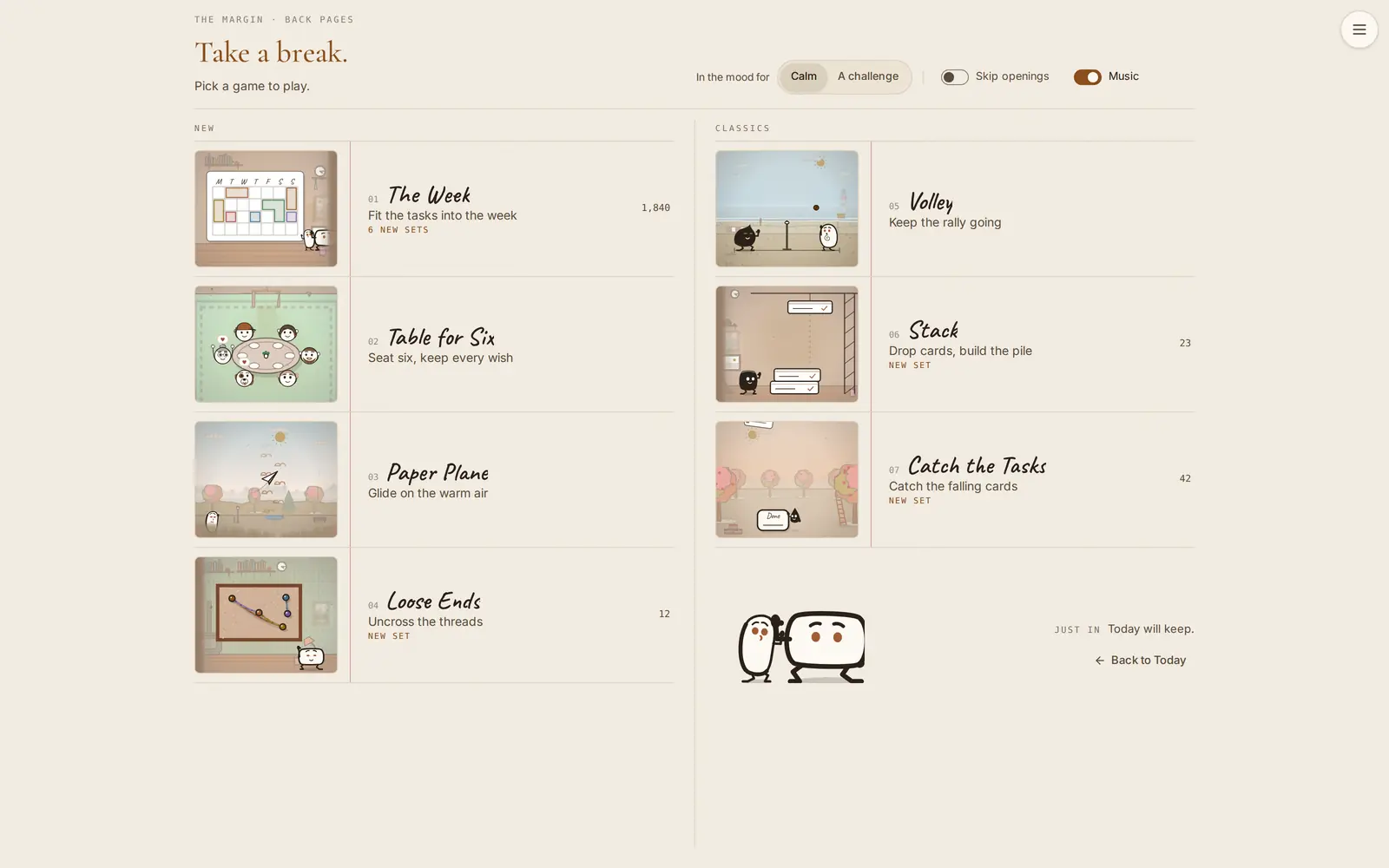
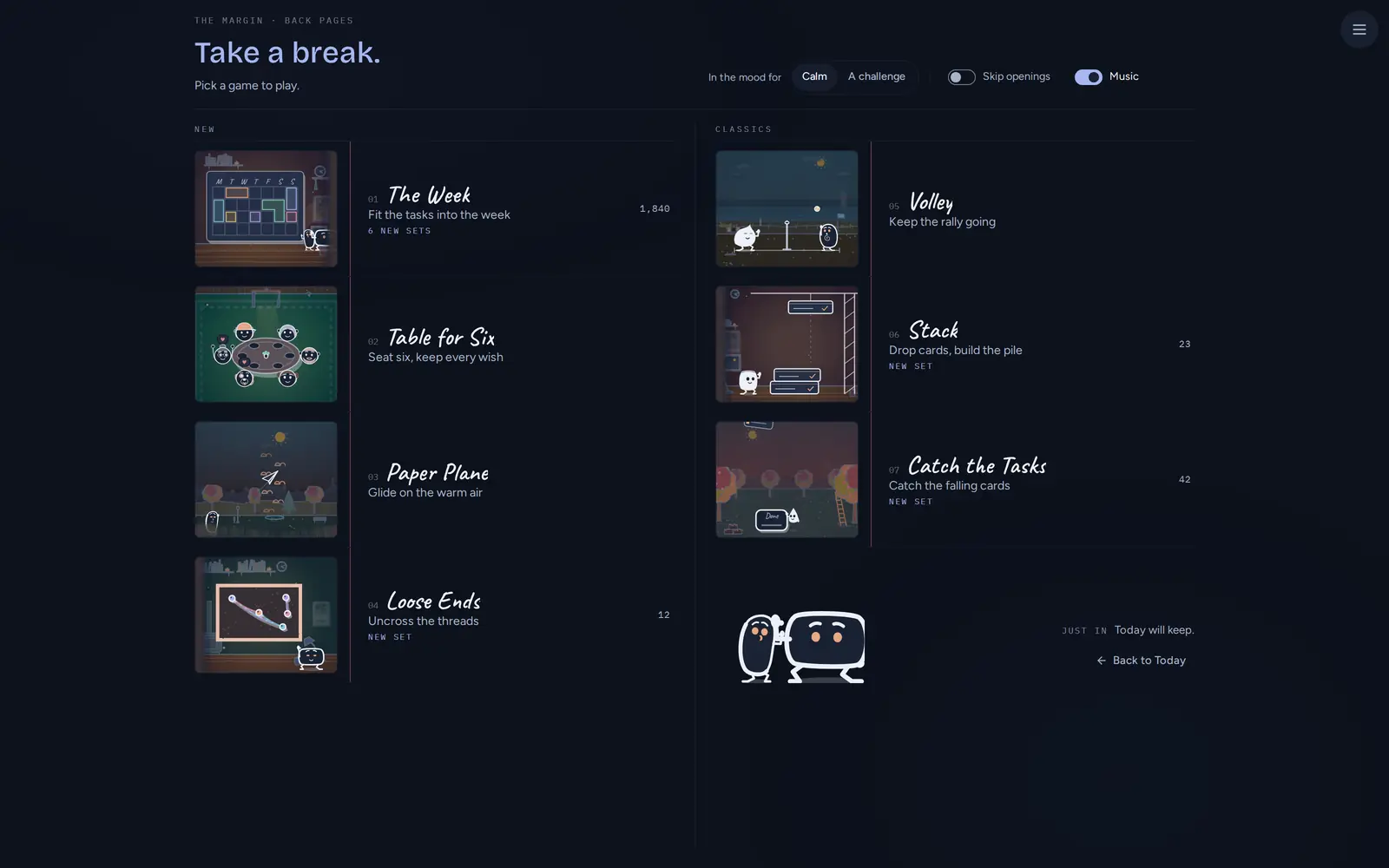
A row tells you what you do in one line, which mode it will reopen in, your best, your stars, and whether a pack is waiting that you haven't opened. The room used to jump straight back into your last game, which made the shelf easy to never see. It opens on the back pages every time now, and a ribbon on your last game is the one-press way back in. Every row opens, Volley's included, since its rebuild brought it to the web. The little windows share one loop, ticking over at about a dozen frames a second and at 30 under the pointer. They stop when they're off screen and hold still under reduced motion, and a game's own code only downloads when you open it. After five minutes Jot, at the foot of the page, waves once.